Does Flossing Really Prevent Gum Disease?
Posted on 9/6/2026 by Singing River Dentistry - Muscle Shoals |
 If you have ever wondered whether flossing really prevents gum disease, you are not alone. A few years back, a wave of news coverage suggested the evidence behind flossing was weaker than dentists claimed, and many patients in Muscle Shoals took that as quiet permission to stop. The headlines stuck. The follow-up reporting did not. If you have ever wondered whether flossing really prevents gum disease, you are not alone. A few years back, a wave of news coverage suggested the evidence behind flossing was weaker than dentists claimed, and many patients in Muscle Shoals took that as quiet permission to stop. The headlines stuck. The follow-up reporting did not.
The short answer is yes, flossing prevents gum disease, and the news story that suggested otherwise was misread. This post walks through what the research actually said, why dentists keep recommending floss even when patients push back, what flossing correctly looks like, and the alternatives that work just as well for people who cannot or will not use string floss.
If you are revisiting your daily routine as part of broader preventive dental care, understanding why this one habit matters can be the difference between gums that stay healthy for life and gums that quietly recede until something has to be done about it.
On This Page
Where the Flossing-Does-Not-Work Story Came From
In 2016, a wire-service investigation pointed out that the federal dietary guidelines had quietly dropped the flossing recommendation, and that the studies cited for years to support flossing were short, small, and not rigorously designed by modern standards. The headlines ran with it: the government, the stories implied, had just admitted flossing does not work. Patients heard the message.
That is not what the reporting actually said, though. The investigation pointed to a lack of large, long-term randomized trials, not to evidence that flossing fails. The two are completely different. The reason those trials do not exist is practical, not scientific: studying flossing rigorously means assigning one group of people not to floss for years and then tracking the gum disease that develops. That kind of study is hard to fund and hard to run ethically when every dentist treating those patients believes the non-flossing group is being harmed.
What dentists actually have is decades of clinical observation. We see, every day, the difference between patients who floss consistently and patients who do not. The difference shows up in their gums, in their X-rays, and in the cleanings their hygienists have to do.
What Actually Happens Between Your Teeth
To understand why flossing matters, it helps to understand where gum disease actually starts. It does not begin on the smooth front and back surfaces of your teeth where the toothbrush easily reaches. It begins in the spaces between teeth and just below the gumline where the brush cannot get.
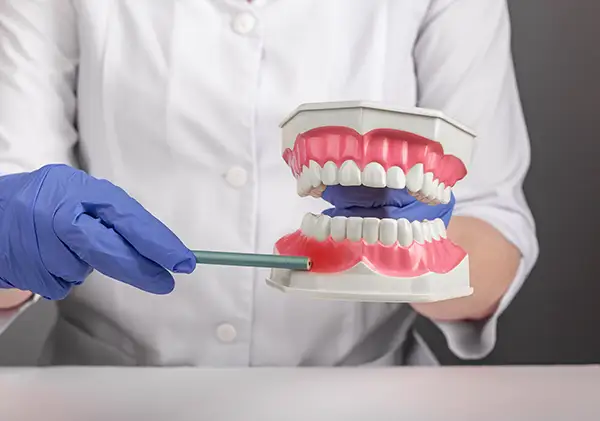 The mechanism is consistent. Plaque, a soft bacterial film, builds up between the teeth within hours of eating. If it is not removed, it hardens into tartar within a day or two, and tartar can no longer be brushed away. The bacteria continue producing acids and toxins that irritate the gums, and the gums respond by becoming inflamed. That early inflammation is gingivitis. The mechanism is consistent. Plaque, a soft bacterial film, builds up between the teeth within hours of eating. If it is not removed, it hardens into tartar within a day or two, and tartar can no longer be brushed away. The bacteria continue producing acids and toxins that irritate the gums, and the gums respond by becoming inflamed. That early inflammation is gingivitis.
If the inflammation continues, the gum tissue pulls slightly away from the tooth, creating a small pocket where more bacteria collect. The pockets deepen, the bone underneath begins to lose density, and what started as a minor irritation becomes the kind of advanced gum problem that requires periodontal care to bring back under control.
The whole cascade starts in spaces a toothbrush cannot reach. Brushing twice daily handles the smooth surfaces. Flossing handles the in-between spaces and the gumline. The two are not redundant; they cover different ground.
How to Floss Correctly
Most patients who tell us flossing does not seem to do anything are flossing in a way that is not actually cleaning. A few small technique adjustments make the difference.
| 1. |
Use enough floss – about 18 inches is right; wrap most of it around your middle fingers, leaving an inch or two of working surface between them
|
| 2. |
Move gently between the teeth – use a soft sawing motion until the floss slips past the contact point, rather than snapping it down hard
|
| 3. |
Curve the floss against each tooth in a C-shape – this is the step most people skip; curve the floss around the side of one tooth and slide it gently below the gumline, then repeat against the adjacent tooth
|
| 4. |
Use a clean section for each gap – sliding the same section through every space just redistributes bacteria; advance the floss as you go |
Once daily is the target. Twice does not add much, and zero days does most of the damage. The bacteria need consistent disruption, and the worst time for them to build up undisturbed is overnight, so evening flossing is what we usually suggest.
Alternatives to String Floss
Some patients struggle with string floss for genuine reasons: limited hand dexterity, bridgework, dental implants, orthodontic brackets, or simply finding the process too unpleasant to do consistently. The good news is the goal is cleaning between the teeth, not specifically using string floss. Several alternatives reach the same area effectively.
Water flossers use a stream of pulsed water to clear plaque and debris between teeth and below the gumline. They are especially useful for patients with bridges, implants, or braces, where string floss is hard to thread through. Studies have shown water flossers reduce gum inflammation effectively when used daily.
Interdental brushes are tiny cone-shaped brushes that fit between teeth. They work well in spaces wider than a normal contact point, and they are often more thorough than string floss for patients with some gum recession.
Floss picks, the small handled tools with a piece of floss stretched across them, are not quite as effective as traditional floss because they do not allow the C-shape technique as easily. Still, they are far better than nothing. For patients with arthritis or limited grip, a floss pick at the end of the day is a real improvement over giving up entirely.
The best interdental method is the one you will actually use daily. Whatever works for your mouth, your hands, and your routine is the right choice.
Setting Realistic Expectations
Flossing is not magic, and the change it produces is not immediate or dramatic. What it does is prevent a slow, steady process that you cannot see happening until it is well underway. Daily flossing, regular brushing, and consistent professional cleanings form a maintenance triangle that keeps gums healthy for decades.
A realistic timeline matters here. When a patient starts flossing after a long gap, the gums may bleed for the first week or two. That is the existing inflammation in the tissue responding to being cleaned, not a sign of damage. With consistent flossing, the bleeding typically stops within two to three weeks as the gum tissue becomes healthier.
A realistic context matters too. Flossing alone will not reverse advanced periodontal disease. If gum disease has already progressed past gingivitis, a hygienist’s periodontal maintenance cleanings are necessary in addition to home care to clear what has accumulated below the gumline.
And the realistic alternative is worth saying out loud: not flossing slowly worsens gum health in essentially everyone. We have not yet seen the rare patient whose gums stay perfect despite never flossing, and we have seen many patients whose lifelong avoidance of floss has led to expensive restorative work that flossing would have prevented.
Help in Muscle Shoals
If your routine has slipped and you are not sure where your gum health stands, our team at Singing River Dentistry in Muscle Shoals can give you a baseline at your next visit. Call 256-383-1112 or visit our practice homepage to schedule a checkup.
Frequently Asked Questions
Is it okay to skip flossing if I brush really well?
No. Brushing reaches the smooth surfaces of your teeth, but it cannot get between them or below the gumline where gum disease starts. No matter how thoroughly you brush, the spaces between your teeth still need a separate cleaning.
My gums bleed when I floss. Should I stop?
Usually no. Bleeding is a sign of gum inflammation that is already there. If you continue flossing gently and consistently, the bleeding usually stops within two to three weeks as the gums become healthier. If bleeding continues past that point or is heavy, ask your dentist to check for deeper gum issues.
Is a water flosser as good as string floss?
For most patients, yes. Studies have shown water flossers significantly reduce gum inflammation when used daily, and they are especially useful for patients with bridges, implants, or braces. The key is using whichever tool you have, every day.
When is the best time to floss, morning or night?
Night is usually the better choice. Bacteria that are not cleared out at night sit undisturbed for several hours, which is when they do the most damage. Flossing before brushing in the evening clears the spaces, and brushing afterward cleans up what is dislodged.
How often should I see the dentist if I floss every day?
Twice a year is the standard recommendation for most adults, even those with excellent home care. Patients with a history of gum disease often benefit from cleanings every three to four months. Your dentist will recommend an interval based on your specific situation.
|
|