Periodontal Health
Posted on 4/1/2026 by Singing River Dentistry - Helton Drive |
 Let's talk about something super important for your overall health and smile: your gums! Often overlooked, gum health, also known as periodontal health, is the foundation for strong, healthy teeth. When your gums aren't in good shape, it can lead to some serious problems, not just in your mouth, but potentially in other parts of your body too. Let's talk about something super important for your overall health and smile: your gums! Often overlooked, gum health, also known as periodontal health, is the foundation for strong, healthy teeth. When your gums aren't in good shape, it can lead to some serious problems, not just in your mouth, but potentially in other parts of your body too.
What is Periodontal Disease?
Periodontal disease, often called gum disease, is an infection that damages the soft tissues and bone that support your teeth. It starts with plaque, that sticky film that forms on your teeth. If plaque isn't removed by brushing and flossing, it hardens into tartar (also called calculus). Tartar can only be removed by a dental professional.
The longer plaque and tartar stay on your teeth, the more irritating they become to your gums. This irritation leads to inflammation, which is the hallmark of gingivitis, the early stage of gum disease.
Gingivitis: The Reversible Stage
Gingivitis is when your gums become red, swollen, and bleed easily, especially when you brush or floss. The good news is that gingivitis is often reversible with good oral hygiene and professional dental cleanings. By removing the plaque and tartar and improving your at-home care, your gums can return to a healthy state.
Periodontitis: When Things Get Serious
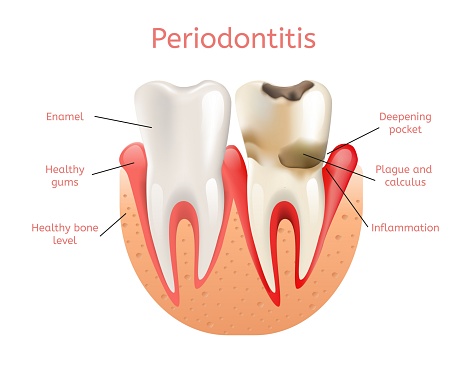
If gingivitis isn't treated, it can progress to periodontitis. In periodontitis, the inflammation spreads below the gum line. The gums begin to pull away from the teeth, forming pockets that become infected. The body's immune system fights the bacteria, but this response, combined with the bacteria themselves, breaks down the bone and connective tissue that hold teeth in place.
Over time, the pockets deepen, and more bone and tissue are destroyed. Eventually, teeth can become loose and may need to be removed. Periodontitis is a chronic inflammatory disease.
Risk Factors for Periodontal Disease
Several factors can increase your risk of developing periodontal disease:
| • |
Poor Oral Hygiene: Not brushing and flossing regularly allows plaque and tartar to build up. |
| • |
Smoking: Smoking weakens the immune system, making it harder to fight off gum infections and slowing down healing. |
| • |
Genetics: Some people are genetically more susceptible to gum disease. |
| • |
Certain Illnesses: Conditions like diabetes can make you more prone to infections, including gum disease. |
| • |
Certain Medications: Some medications can reduce saliva flow, which can contribute to plaque buildup. |
| • |
Age: The risk of gum disease increases with age. |
Signs and Symptoms
Sometimes, gum disease can be present without obvious symptoms, which is why regular dental checkups are so important. However, some common signs include:
| • |
Red, swollen, or tender gums |
| • |
Bleeding gums when brushing or flossing |
| • |
Gums that have pulled away from the teeth |
| • |
Persistent bad breath |
| • |
Loose teeth |
| • |
Changes in your bite |
| • |
Pus between your teeth and gums |
Prevention is Key
Preventing periodontal disease is much easier than treating it. Here are some tips:
| • |
Brush your teeth twice a day with fluoride toothpaste. |
| • |
Floss daily to remove plaque and food particles from between your teeth. |
| • |
Visit your dentist regularly for checkups and professional cleanings. |
| • |
Don't smoke. |
| • |
Maintain a healthy diet. |
Taking care of your gums is an investment in your overall health. By understanding the importance of periodontal health and taking proactive steps to prevent gum disease, you can keep your smile healthy and bright for years to come!
|
|

